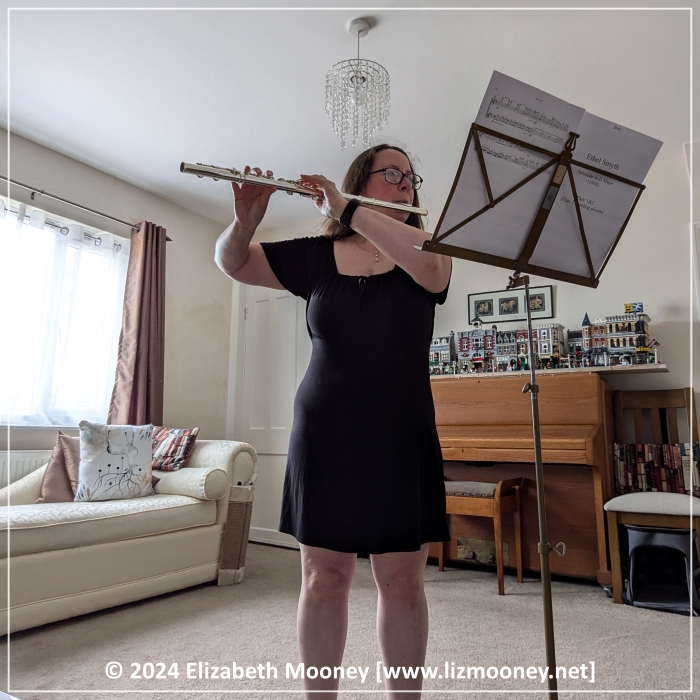
I don’t usually do videos however this is a short excerpt of me this morning sight reading quite a difficult piece while listening to a recording on YouTube, for a concert this evening 😅 Shot on an 10 year old iPad with zero editing, my sound is awful but I promise if you come to the concert it will sound better!
I wanted to share with you an insight into three key skills you need to be a second flute/piccolo player, which is what I’m playing in this concert. For those of you unaware of the makeup of a chamber orchestra, generally in the wind section (flute, clarinet, oboe, bassoon) there only two people per instrument – each with our own part – unlike in the string section (violin, viola, cello and double bass) where there is a cast of 1,000’s.
Not to be disrespectful to string players, who have mastered very different skills in order to play in a section, much like the brass section it’s essential we know what we are doing because often our parts are quite exposed. If we go wrong there is no one to help us find our way back, and if we play a wrong note it can be very noticeable.
1 So first and foremost, the key skill of a second flute player is the ability to count! This is because we have many, many, many bars rest – and often come in for just a few notes – which means it’s crucial we have excellent timing.
2 Secondly, we need to be able to pick up our instruments (after the many, many bars rest) and be able to play from cold, in tune. The temperature of the flute affects the tuning because it is metal, and when it’s not played it gets cold and goes out of tune. That is why you might see flute players blowing into the mouthpiece before playing to try and warm the tube up.
3 The third thing, which I will need to contend with this concert, is that often the 2nd flute is required to play a second instrument – the piccolo – which is basically a miniature flute. This is challenging because the piccolo, being a similar but different instrument, needs a slightly different embouchure (basically the position of the mouth) to the flute. Often you are required for short passages to quickly swap between the two instruments, and without regularly practicing going from one instrument to another, sometimes when you go to play nothing comes out! This is because your mouth thinks it’s playing the flute.
So there we have it. Wish me luck, and if you would like to come to the concert this evening the details can be found here.
The piece is Serenade in D by Ethel Smyth, it is available on YouTube at: https://youtu.be/LLzRdtgP1j0?si=U0ELDTtReN4JABYN
 Elizabeth Mooney
Hiya -it’s a bit far to come this evening, Liz, but I look forward to hearing you at a concert in London at some point. Fascinating thoughts on the flute above, I never thought about them before. Best wishes Liz xx
LikeLike